A new camera for low-light hours
TL;DR. Captured images were often blurred in the early and late hours. Replaced the existing camera (E1 Outdoor, 1/2.8” CMOS, f/1.6) with the CX410W (1/1.8” CMOS, f/1.0), which is designed for low-light performance. Updated the speed measurement to d/t over an accumulating window inside the homography grid. Burned the grid and v=d/t overlay into recorded clips so each is self-contained.
Follows camwatch-1, camwatch-2, and camwatch-3.
The camera
The E1 Outdoor was sharp in good light but smeared moving cars at dawn and dusk. Auto-exposure cranks shutter time up to compensate for low light, and fast-moving subjects come out as elongated blurs. The shoulder hours were effectively a hole in the data for the vehicle enrichment pipeline (make, model, color), which needs sharp body lines to work.
The CX410W has a larger sensor and a wider aperture:
| E1 Outdoor | CX410W | |
|---|---|---|
| Sensor | 1/2.8” CMOS | 1/1.8” CMOS |
| Aperture | f/1.6 | f/1.0 |
A larger sensor catches more photons; a wider aperture admits more light per unit shutter time. Together they cut required shutter time enough that motion blur at dawn and dusk is gone, while the rest of the day stays sharp.
The speed estimator
The new camera came with one downstream surprise: per-frame PTS timestamps are less stable than they were on the E1. We see bursts where five or six frames cluster near the same PTS, then the next frame jumps forward. The trajectory-regression method from camwatch-2 is sensitive to clustered outliers.
The replacement is an accumulating cumulative-distance-over-cumulative-time average:
- cum_dist += hypot(ΔX, ΔY) and cum_dt = t_i − t_0 from the first in-grid sample.
- Reports mph_i = (cum_dist / cum_dt) × MPH_PER_MPS at each frame; the final value is the headline.
- 0.5 m hysteresis on grid exit so a single border frame doesn’t pop the average.
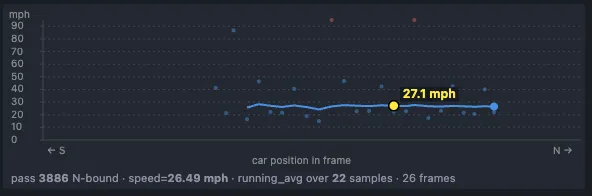
Pass 3886 is a clean illustration. Most per-frame samples sit between 20 and 30 mph; a handful of PTS-burst outliers shoot up to 70+ mph. The running average passes through the well-behaved cluster and treats the outliers for what they are: a single bad sample is just a single bad sample, it can’t rotate the line. The headline reads 26.49 mph.
Self-contained video clips
Recorded clips used to render the grid as a client-side overlay on top of the playback <video>. That worked when the live grid matched the clip’s grid. After a camera swap or any recalibration, old clips replayed under the wrong overlay.
The fix is to burn the grid and the v=d/t overlay into the pixels of every new clip at write time, so the clip is self-evident at any future point. cv2.polylines for the grid, cv2.putText for the d / t / V block above the bounding box, cv2.circle for the trail.
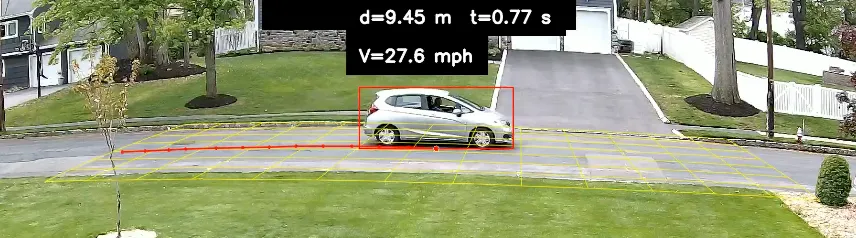
Same information is in the clip as on the live dashboard, with no out-of-band state required.
Low-light, before and after
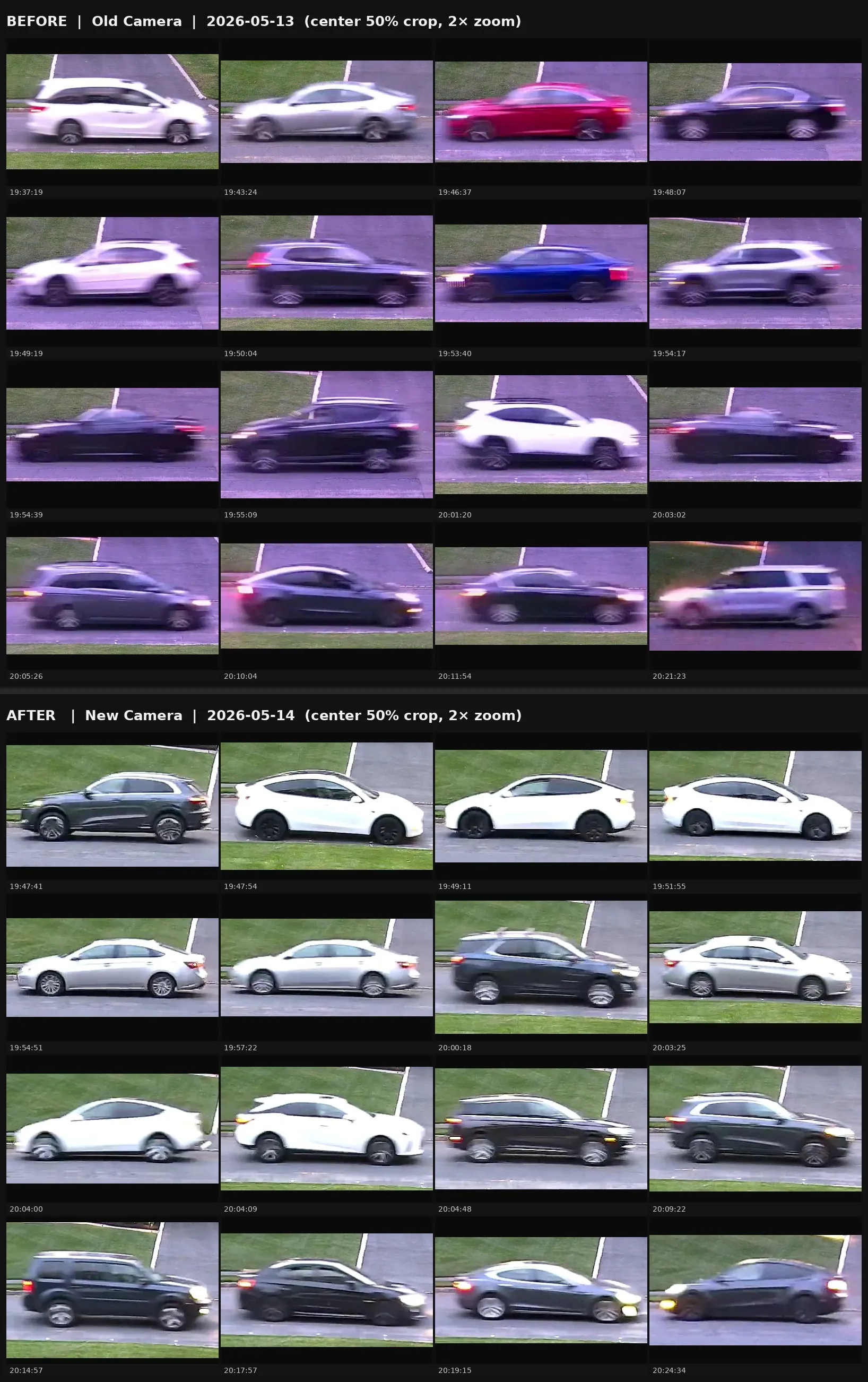
Same dusk window on two consecutive nights. The CX410W keeps body detail through low light; the E1 doesn’t.
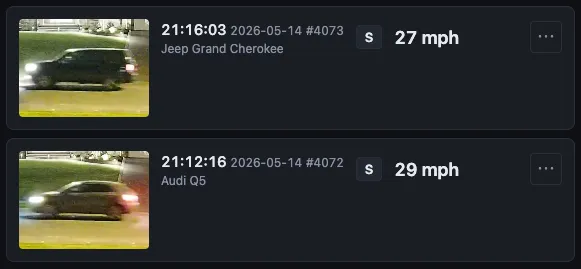
Pushing further into the night, pass 4070 at 08:58:38 PM (well past sunset, visually dark) is still producing a detected, color, speed-measured frame:
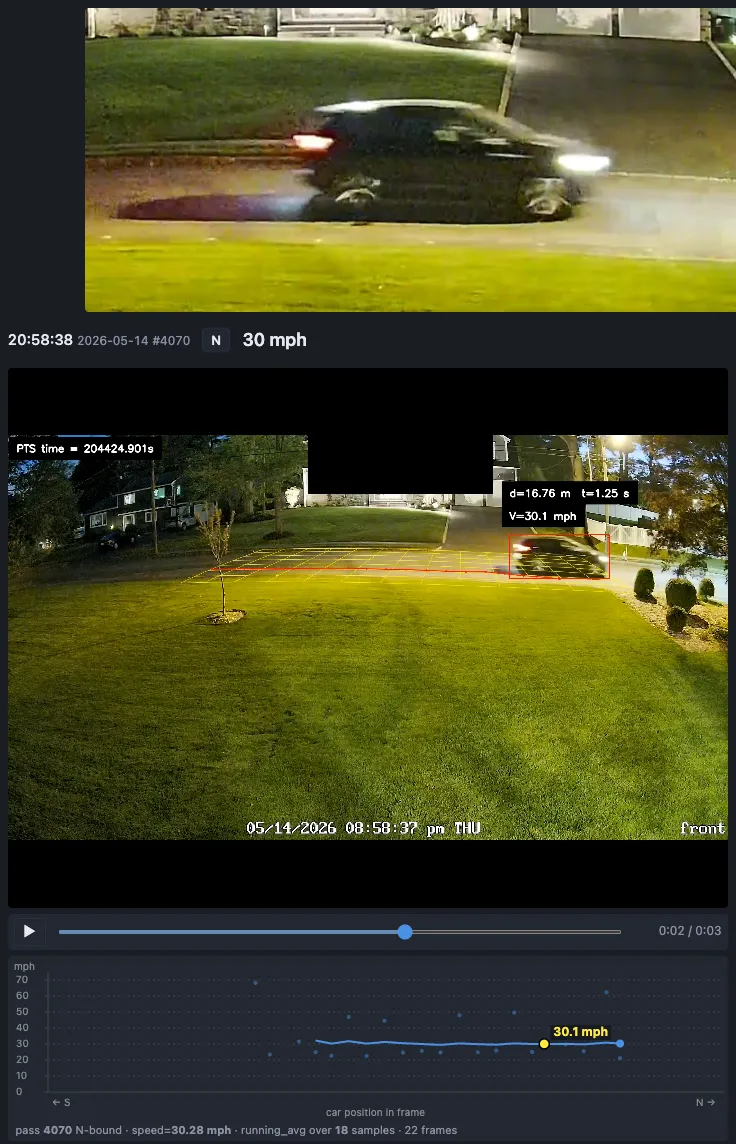
Motion blur on the body is real and the headlights bloom, but the car was still detected, tracked, and timed end to end. The running average lands at 30.28 mph.